


Katsushika Hokusai
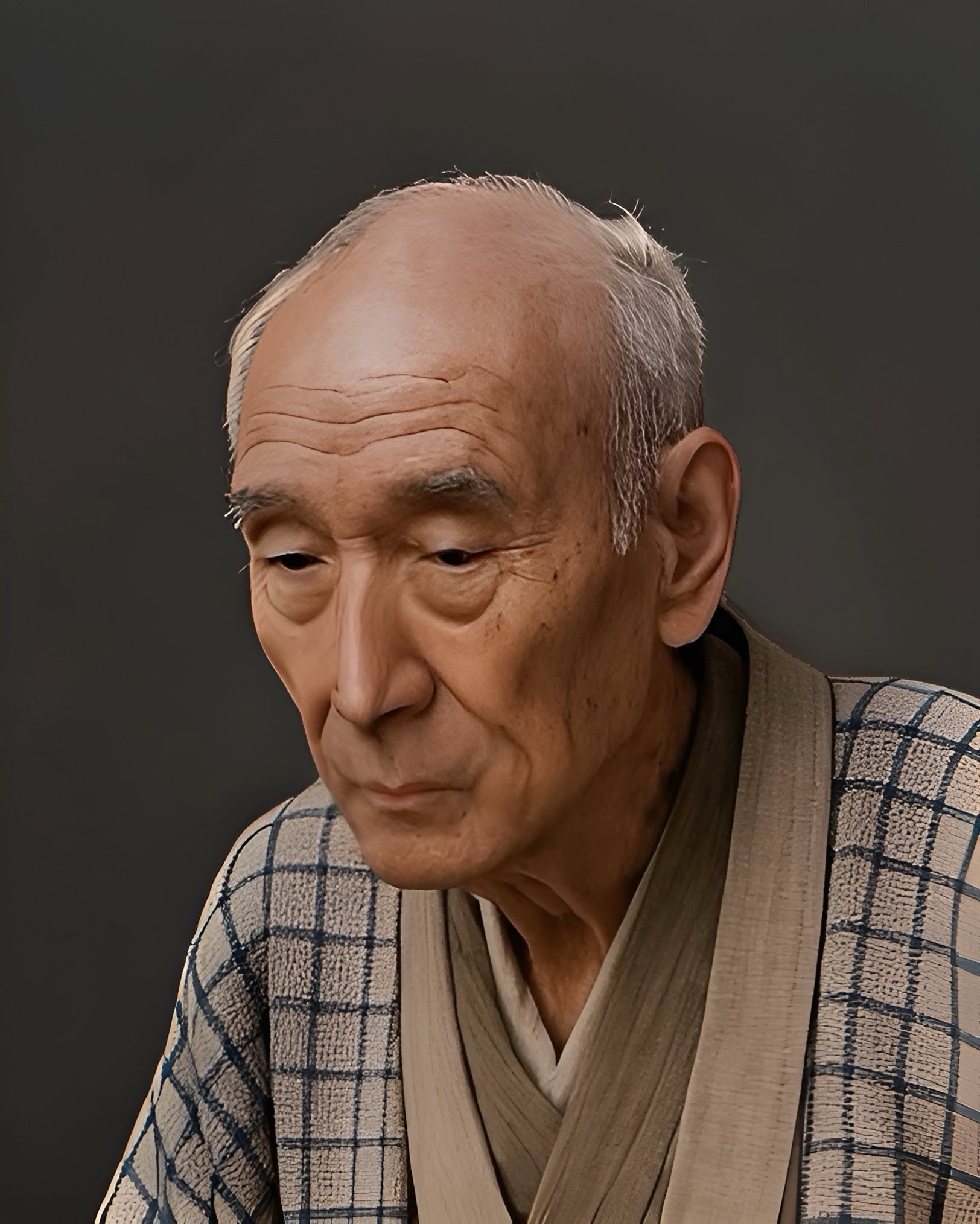
Katsushika Hokusai was born in 1760 in Edo, present-day Tokyo, in the area now known as “Sumida-ku” (墨田区), or Sumida City. It is believed that his birthplace lay very close to the site of the modern Sumida Hokusai Museum (Japanese: すみだ北斎美術館), approximately a thirty-seven-minute walk from the location of his grave.
The name “Sumida” (墨田) derives from one of Tokyo’s most important rivers, whose waters once irrigated rice fields and inspired the brushes of great artists and renowned printing workshops. The term “ku” (区) denotes an administrative district.
The master of Ukiyo-e was born into a modest family closely tied to artisanal work: his adoptive father, Nakajima Ise, served as a craftsman in a shogunal workshop specializing in decorative metal mirrors. Although Hokusai was not officially recognized as a legitimate son, his visual education began early under the influence of his father’s craft. Little is known about his mother, yet she is thought to have played a quiet but decisive role in a childhood marked by early independence. Hokusai showed a strong inclination for woodblock printing from an early age, apprenticing first in a printing house and later in the atelier of the master Katsukawa Shunshō, where his true artistic formation began.
Throughout his long life, Hokusai had several wives and at least five children, though his closest bond was with his daughter Katsushika Ōi, also known as O-Ei, who, besides being an accomplished artist, became his closest collaborator in old age. Ōi inherited not only his technique but also his restless spirit, distinguishing herself through her depictions of women and her refined command of light, even if her talent remained under the shadow of her father’s renown. Hokusai was a pivotal figure within the ukiyo-e movement, yet he expanded the genre’s boundaries by incorporating elements of landscape, scientific inquiry, and Buddhist spirituality, most notably in his celebrated series “Thirty-Six Views of Mount Fuji.”
His art profoundly influenced the European Impressionists, particularly Claude Monet, Edgar Degas and Vincent van Gogh, who admired his dynamic compositions and spontaneous linework. Technically, he introduced the innovative use of Western perspective into Japanese printmaking, revolutionizing spatial perception, while his work—echoing throughout Impressionist Europe—sparked the cultural phenomenon later known as Japonisme. His view of nature as a living, animating force also resonated with the ideals of European Romanticism. Despite often living in poverty, Hokusai changed his artistic name over thirty times, as though with each transformation he renewed his vision of the world.
Beyond the mountains, waves, and dragons that inhabit his oeuvre, Hokusai left a radical lesson: art is not merely what is seen, but what is transformed through time, blood, and will.


